

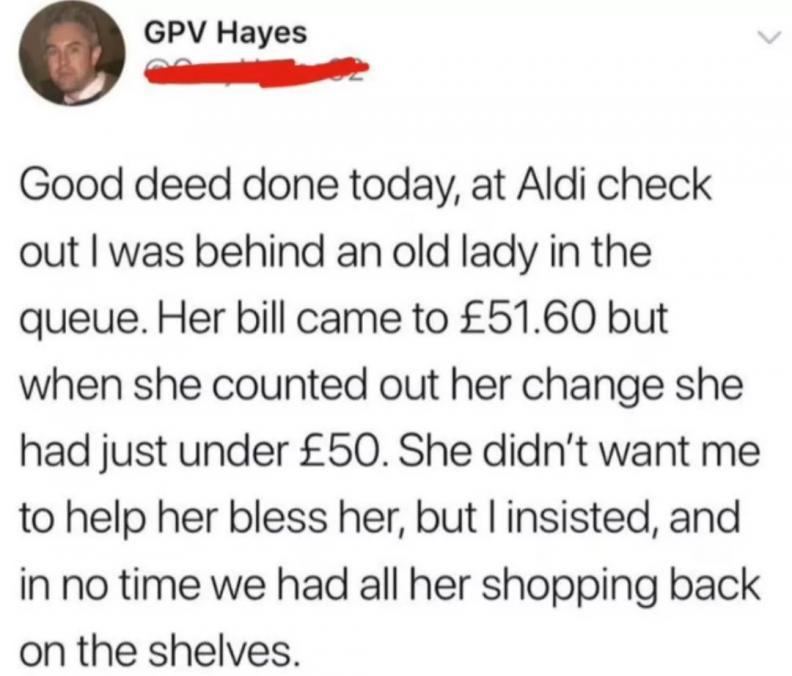
Ha ha. I like the joke. I’m reminded of the old joke that goes, The man seemed to be all over the road. I swerved and swerved before I finally hit him.
I see a whole host of errors in the above meme, and as is true to form with modern UK writers, the comma hatred here is screamingly obvious.
Let me first reproduce the poorly written text:
Good deed done today, at Aldi check out I was behind an old lady in the queue. Her bill came to £51.60 but when she counted out her change she had just under £50. She didn’t want me to help her bless her, but I insisted, and in no time we had all her shopping back on the shelves.
And now… let’s go through this mess line by line.
That entire first sentence needs better punctuation. There are several ways to improve it. My preference: Good deed done today at Aldi checkout: I was behind an old lady in the queue. Strangely, the first comma problem is an unnecessary comma, not a missing one—a rare instance of (misguided) British comma-love. The colon in my improved version indicates that an explanation is to come. Don’t like the colon? Use an em dash instead. In both US and UK English, the cashier’s area is called the checkout, not the check out. To check out is a phrasal verb. It’s also American slang for to ogle/leer or even to die. As in: Quit checkin’ her out, man. She sees you. (or) Private Boniface checked out when he got in front of a Claymore to save Henderson during Boniface’s first and only tour.
The second sentence is where we see the British comma-hatred rear its ugly head: Her bill came to £51.60 but when she counted out her change she had just under £50. (By the way, you know this is British English because the writer says queue instead of line. The word queue comes from the French word for tail—a line of people looks a bit like a tail—and in French, la queue is also modern slang for your dick, which may have looked like a long tail to some very well-endowed Frenchman.) Anyway, let’s rewrite the sentence: Her bill came to £51.60, but when she counted out her change, she had just under £50. The first comma in my version ostensibly separates two independent clauses, but you may have noticed that what comes after the comma-but is actually a complex sentence (dependent + independent clause) functioning as the second independent clause. This kind of sentence, taken as a whole from “Her bill” to “under £50,” is called a compound-complex sentence: it’s got two independent clauses and at least one dependent clause. I’ll talk about this a little more below, after we’re done slogging through this sloppiness. The second comma in my version is there because we’re dealing with a complex sentence whose dependent clause comes first. Sentence-initial dependent clauses take a comma. I’ll discuss that below, too.
Behold this final sentence: She didn’t want me to help her bless her, but I insisted, and in no time we had all her shopping back on the shelves. The bless her is an interjection that should be surrounded by a pair of commas. The phrase and in no time is serving as an introductory phrase for the clause that follows it, so there needs to be a comma after time. Rewritten, this would would be: She didn’t want me to help her, bless her, but I insisted, and in no time, we had all her shopping back on the shelves.
So! Cleaned up, the whole text should look like this:
Good deed done today at Aldi checkout: I was behind an old lady in the queue. Her bill came to £51.60, but when she counted out her change, she had just under £50. She didn’t want me to help her, bless her, but I insisted, and in no time, we had all her shopping back on the shelves.
If you dislike having so many commas in the final sentence, break the sentence up into two sentences, and don’t worry about starting a sentence with a coordinating conjunction. That’s one of those faux or passé rules quoted by fake grammar scolds who overcorrect. So the final sentence could be broken up like so:
She didn’t want me to help her, bless her, but I insisted. And in no time, we had all her shopping back on the shelves.
That eliminates at least one comma.
Now, let’s talk about sentence types.
simple sentence = 1 subject (simple/compound) + 1 predicate (simple/compound)
compound sentence = at least 2 independent clauses
complex sentence = dependent + independent clause
compound-complex sentence = at least 2 indep. clauses + 1 dependent clause
And those basic terms:
subject = the doer of the sentence’s action; the sentence’s “main character”
predicate = the “verby” part of the sentence, showing actions or states
clause = a group of words with a subject and a related predicate
independent clause = a clause that stands on its own as a complete thought
dependent (subordinate) clause = a clause that is an incomplete thought, needing an independent clause to become complete
conjunction (junct → Latin iugare/iunct, “join”) = a word that connects or conjoins two elements in a phrase or sentence
coordinating conjunction = used in compound sentences to conjoin two independent clauses (FANBOYS: for, and, nor, but, or, yet, so)
subordinating conjunctions = used to introduce dependent/subordinate clauses in complex sentences (words like: although, if, until, because, after, before, even though, when, that, etc.)
Examples of sentence types:
SIMPLE: Theresa sharted.
COMPOUND: Theresa sharted, and the class prayed for mercy.
COMPLEX: When Theresa sharted, the class prayed for mercy.
COMPOUND-COMPLEX: When Theresa sharted, the class prayed for mercy, and the nearby police department deployed SWAT and HAZMAT teams.
Compound sentences contain two or more independent clauses normally linked by a comma-conjunction or a semicolon (or a colon, or an em dash, etc.). Examples:
The man was all over the road, but I finally hit him. (comma-but)
The waiter minced fearfully up to our table; I grinned wolfishly. (semicolon)
Did you gain weight, or is your body covered with water bladders? (comma-or)
You need to take all of your clothes off: it’s the law in this county. (colon)
Whales make TikTok vids—we just found this out. (em dash)
With complex sentences, if the dependent clause comes first, stick a comma on the end of the clause. Here are some examples:
When Eric gave birth to carnivorous alien babies, the town was delighted.
Because you have thirteen fingers, I love you.
Unless you marry Pig Knuckles, the county won’t let you have the parking space.
When the dependent clause comes last, there’s no intervening comma.
The town was delighted when Eric gave birth to carnivorous alien babies.
I love you because you have thirteen fingers.
The county won’t let you have the parking space unless you marry Pig Knuckles.
What compound-complex sentences look like:
When Frida saw the shadow, she screamed, and her cat exploded.
I’m not doing your work for you, and Tom isn’t helping you, either, until you pay us half of your salary right now.
Before we realized it was a terrorist attack, Marlon was joking about clowns, and Andy was sniffing his pits.
Reminder: simple sentences sometimes don’t look very simple because they might have compound subjects and predicates (two or more actors, two or more actions), but however complicated they look, they have only one single clause. Here are some simple sentences whose appearances are deceiving:
Hal, Clark, and Bruce went drinking and got trashed. (3 subj., 2 pred.)
Martha and your mom came over last night and were amazing. (2 subj., 2 pred.)
The people and the sea monsters both agreed about their equal skill at pie-making, decided the contest was a draw, and departed peaceably. (2 subj., 3 pred.)
I don’t normally leave quizzes here in the Superficial (free) section of my Substack, but if you want, try your hand at this one.
QUIZ
Are the following sentences simple, compound, complex, or compound-complex?
If the wind keeps up its infernal howling for the third day in a row, the dogs are going to start singing Die Zauberflöte again soon.
I hate it when Byron plays the saxophone naked and refuses to use his mouth when playing; it’s a bit rude.
Ever alert, Angie’s armpits hissed a sudden warning, but it was too late, for the pterodactyls had found them again.
Cocaine, mouthwash, and Jolly Ranchers come together as my favorite microwave post-orgy cocktail and never fail to pep me up.
Buttlestar Buttsmacktica is by far the greatest spanking-fetish porn movie from the early, post-9/11 2000s.
Scroll down for the answers and quick explanations.
.
.
.
.
.
.
.
.
.
.
complex (1 dependent clause, 1 independent clause)
compound-complex (1 indep. clause, 1 dependent clause, 1 indep. clause)
compound (3 independent clauses)
simple (compound subject, compound predicate)
simple (1 subject, 1 predicate)
Subscribe to the paid Substack to get mini-quizzes like this all the time. And more in-depth, interactive quizzes and tests are also on the way. Patience.
ADDENDUM: Quizzes are now here! Visit this site, find the quiz with the relevant unit numbers, be mindful of what topics are covered in each unit, and take the quiz(zes) as many times as you want. Nothing is recorded, so don’t feel bad if you stumble. Just pick yourself up, dust yourself off, study a bit more, and try again. You can also take a “snapshot” of your completed quiz, email it to me, and I can help you review by giving you hints as to the correct answers.
Jack Benny would have paired that down to two or three lines.