

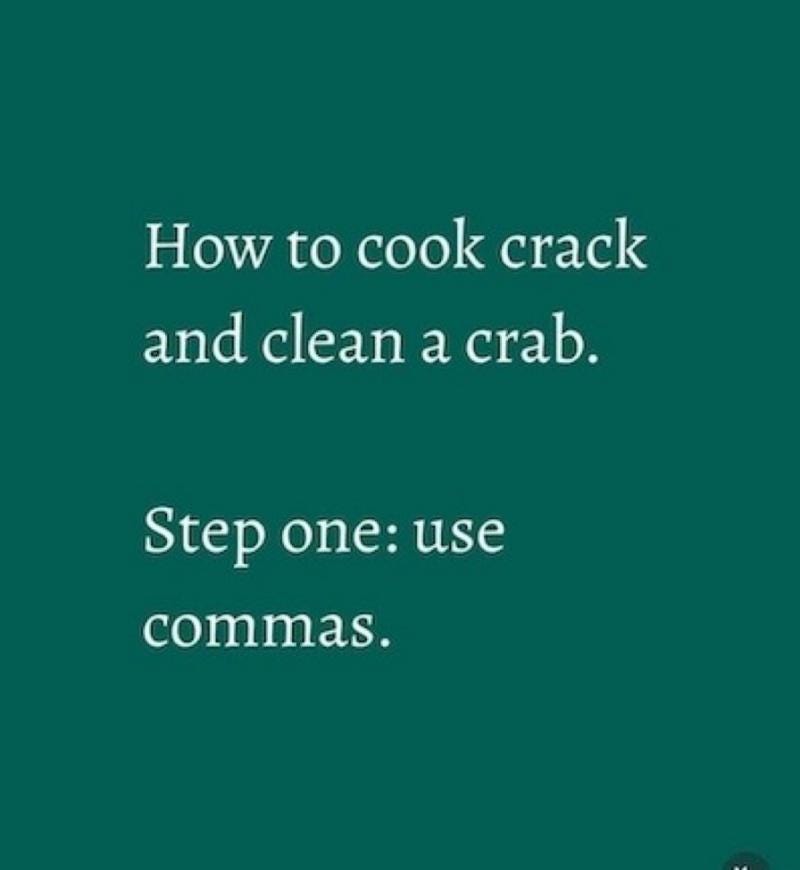
This meme is actually pointing out one or more errors—a public service!
.
.
.
.
.
.
.
.
.
.
If we were to insert commas into the above text (thereby ruining the joke, yes), how many would we need, and where would they go? There are two answers, one of which I think is better than the other.
How to cook, crack and clean a crab. Some would argue that this is serviceable. It’s good enough. I disagree, but technically, this punctuation is plausible.
How to cook, crack, and clean a crab. The comma before the and is what we call an Oxford comma or a serial comma. In lists of three or more items that end with and before the final list item, it’s often recommended to use the Oxford comma, and I agree. The usual reason given for using the Oxford comma is that it helps with clarity.
• I’d like to thank my parents, God and Satan. (God and Satan = my parents???)
• I’d like to thank my parents, God, and Satan. (I’m thanking four entities.)
Note that there is some scholarly pushback against this sentiment. Not everyone agrees that Oxford commas improve clarity.
There is a third possible error, one that might be excusable depending on which style guide you’re following. But technically, if what comes after the colon is a complete sentence, then the sentence ought to be capitalized. So:
Step one: Use commas.
I’ve been guilty of the above error—if we insist on calling it an error—for a long time. I’m now trying to clean up my act. British English doesn’t make the same insistence about capitalization, so maybe I’ve been inadvertently British this whole time.
Getting back to the meme, though: Of course, it’s possible that the meme writer intended to provide a how-to on both cooking crack and cleaning crabs—skills guaranteed to attract the ladies.
Conclusion: The Oxford comma is technically optional but recommended.
Does "inadvertently" modify "British," or a way of existing?