

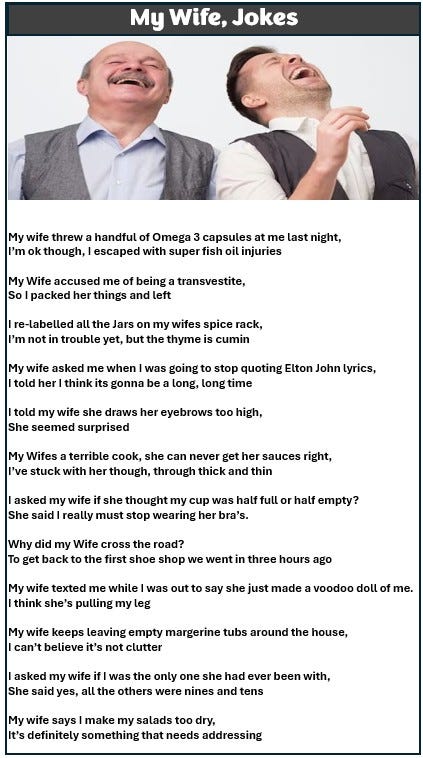
Holy shit. We’ve got our work cut out for us in this one, from the title onward.
Scroll down.
.
.
.
.
.
.
.
.
.
.
Let’s deal with the title first. It currently says:
My Wife, Jokes
But why?
The comma has no earthly reason to be there, and there are several ways to rewrite the title so it looks as though someone who wasn’t retarded had written it.
Some possibilities:
“My Wife” Jokes
Jokes About My Wife
My Wife Jokes
Sigh. Okay, moving on, then—
What I’m going to do is reproduce the 2-liners in bold font, when just rewrite everything properly below each joke, then (if I remember to) provide an explanation as to why I made the revisions I did.
My wife threw a handful of Omega 3 capsules at me last night, I’m ok though, I escaped with super fish oil injuries
REVISED: My wife threw a handful of Omega-3 capsules at me last night. I’m OK, though; I escaped with super fish-oil injuries.
EXPLANATION: Hyphenate “Omega-3” (phrasal adjective). Change the comma after “night” to a period (comma splice). Capitalize OK (it’s “okay” or “OK,” never “ok” or “Ok”). Add a comma before “though.” Change the comma after “though” to a semicolon (comma splice). Hyphenate “fish oil” (phrasal adjective). Add period.
We’re off to a ripping start.
My Wife accused me of being a transvestite, So I packed her things and left
My wife accused me of being a transvestite, so I packed her things and left.
EXPLANATION: De-capitalize “wife” (common noun). De-capitalize “so” (I think this was capitalized because the writer thought you should capitalize mid-sentence after a line break—a “rule” sometimes used in poetry, but even in poetry, not everyone follows that guideline). Add a period because we’re not barbarians.
I re-labelled all the Jars on my wife’s spice rack, I’m not in trouble yet, but the time is cumin
REVISED: I re-labelled all the jars on my wife’s spice rack. I’m not in trouble yet, but the time is cumin.
EXPLANATION: De-capitalize “jars” (common noun). Change the comma after “rack” to a period (comma splice). Add a period at the end. This joke might work better in British English than in American English. Cumin is pronounced “kyoo-min” in US English, which ruins the joke. I don’t know British dialects, but I can imagine some folks in the British Isles pronouncing “coming” as something approaching “koomin’.” Winter is koomin’.
My wife asked me when I was going to stop quoting Elton John lyrics, I told her I think it’s gonna be a long, long time
REVISED: My wife asked me when I was going to stop quoting Elton John lyrics. I told her, “I think it’s gonna be a long, long time.”
EXPLANATION: Change the comma after “lyrics” to a period (comma splice). Add a period at the end. There’s a bit of a tense-control problem with “it’s gonna be,” but there’s nothing that can be done about that because the phrase “I think it’s gonna be a long, long time” is part of an Elton John song, so the best solution is to add a comma and quotation marks to show it’s direct discourse. If it were indirect discourse, it’d be: I told her that I thought it’d be a long, long time. But that would ruin the wording of the lyrics.
I told my wife she draws her eyebrows too high, She seemed surprised
REVISED: I told my wife she draws her eyebrows too high. She seemed surprised.
EXPLANATION: Change the comma after “high” to a period (comma splice). Add a period at the end.
My Wifes a terrible cook, she can never get her sauces right, I’ve stuck with her though, through thick and thin
REVISED: My wife’s a terrible cook. She can never get her sauces right. I’ve stuck with her, though, through thick and thin.
EXPLANATION: De-capitalize “wife” (common noun). Add an apostrophe (“wife’s” = “wife is”). Period after “cook” (comma splice). Capitalize “she” (beginning of a new sentence). Change the comma after “right” to a period (comma splice). Add a comma before “though.” Add a period at the end.
I’m amazed when people confuse plurals, “apostrophe-S”es, and possessives.
the 1980’s = wrong
the 1980s = rightits = that thing’s
it’s = it isa lot of book’s = wrong (the so-called grocer’s apostrophe, as in “Lots of onion’s!”)
a lot of books = rightmy cars problem = wrong
my car’s problem = right
I asked my wife if she thought my cup was half full or half empty? She said I really must stop wearing her bra’s.
REVISED: I asked my wife if she thought my cup was half full or half empty. She said I really must stop wearing her bras.
EXPLANATION: Change question mark to period. Remove apostrophe from “bra’s” to make a proper plural. And, wow—he remembered on his own to put a sentence-final period at the end!
People will unnecessarily use question marks when writing declaratives.
WRONG: I asked her where she was?
RIGHT: I asked her where she was. (stating the fact that you asked a question)WRONG: She asked him if he thought she was crazy?
RIGHT: She asked him if he thought she was crazy. (the fact is that she asked)WRONG: I wonder what he did?
RIGHT: I wonder what he did. (declaring your mental state, i.e., you’re wondering)
Why did my Wife cross the road? To get back to the first shoe shop we went in three hours ago
REVISED: Why did my wife cross the road? To get back to the first shoe shop we went in three hours ago.
EXPLANATION: De-capitalize “wife.” Add a period at the end.
My wife texted me while I was out to say she just made a voodoo doll of me. I think she’s pulling my leg
REVISED: My wife texted me while I was out to say she had just made a voodoo doll of me. I think she’s pulling my leg.
EXPLANATION: Change “she just made” to “she had just made” (tense control). Add a period at the end.
This is actually more important than it looks. The tense change I made was from the preterite (or simple-past) tense—“she just made”—to the past-perfect tense—“she had just made.” The reason for the change is that we use the past-perfect tense for past events that happen before other past events.
past event 1: my wife texted me (preterite tense)
past event 2: before texting, she had made a voodoo doll (past event before past event)Other examples of the past perfect:
Before Grandpa died, he had told me about his hidden treasure map.
Before the bear ate the hunter, he’d taken a huge shit to empty his guts.
Stick grenades had been used in WW1 before their use in WW2.And a review of the preterite tense:
to eat → I ate, you ate, she ate, we ate, they ate
to drive → I drove, you drove, he drove, we drove, they drove
to think → I thought, you thought, she thought, we thought, they thoughtIf you become a paid subscriber, you can access my full (and still evolving) grammar curriculum, where I already have pages and pages on verb tenses (if you’re already a paid subscriber, revisit Part 1, Part 2, Part 3, Part 4, and Part 5).
Free subscribers: I’m always happy to have you, but I hope you know you’re getting only 10% of my content. For a measly $5 a month (a burger a month!), you get the other 90%, which includes a full-on grammar curriculum, creative writing, puzzles and games, and God knows what else in the future for no extra cost. I will never raise my subscription rates.
My wife keeps leaving empty margerine tubs around the house, I can’t believe it’s not clutter
REVISED: My wife keeps leaving empty margarine tubs around the house. I can’t believe it’s not clutter.
EXPLANATION: Spell margarine correctly. Replace the comma after “house” with a period (comma splice). Add a period at the end.
When you can’t even spell margarine, you really shouldn’t create memes.
I asked my wife if I was the only one she had ever been with, She said yes, all the others were nines and tens
REVISED: I asked my wife if I was the only one she had ever been with. She said yes—all the others had been nines and tens.
EXPLANATION: The idiot somehow managed to get the tense control right in (what is now) his first sentence, then he fucked it up in the second sentence. Anyway: Change the comma after “with” to a period (comma splice). Change the comma after “yes” to an em dash (better punctuation). Add a period at the end.
My wife says I make my salads too dry, It’s definitely something that needs addressing
REVISED: My wife says I make my salads too dry. It’s definitely something that needs addressing.
EXPLANATION: Change the comma after “dry” to a period (comma splice). Add a period at the end.
So this genius’s main problem is comma splices. If you were too lazy to click over to see what a comma splice is (I had provided a link above), it’s basically when a comma is being improperly used to separate two independent clauses when you need some other solution. Here’s a comma splice followed by several possible fixes.
COMMA SPLICE: You can’t fucking write, you’re a goddamn moron.
FIX #1: You can’t fucking write! You’re a goddamn moron! (passionate anger)
FIX #2: You can’t fucking write. You’re a goddamn moron. (cynical disappointment)
FIX #2: You can’t fucking write; you’re a goddamn moron. (brute statement of fact)
FIX #3: You can’t fucking write: You’re a goddamn moron. (colon = explanation follows)
FIX #4: You can’t fucking write—you’re a goddamn moron. (dramatic reveal of reason)
FIX #5: You can’t fucking write because you’re a goddamn moron. (complex sentence)
FIX #6: You can’t fucking write, and you’re a goddamn moron. (compound sentence)
FIX #7: You can’t fucking write! What’s more, you’re a goddamn moron. (conjunct. adv.)
I could go on and on, but that should be more than enough for yet another meme that could have been funnier if only its creator had had a brain in his thick skull. Most of the memes we’re seeing here strive for clever wit… and almost always fail because the writers simply don’t know how to write.